
French company FDE finds near-50% hydrogen concentrations at depth — targets production in 2028
French company FDE finds near-50% hydrogen concentrations at depth — targets production in 2028
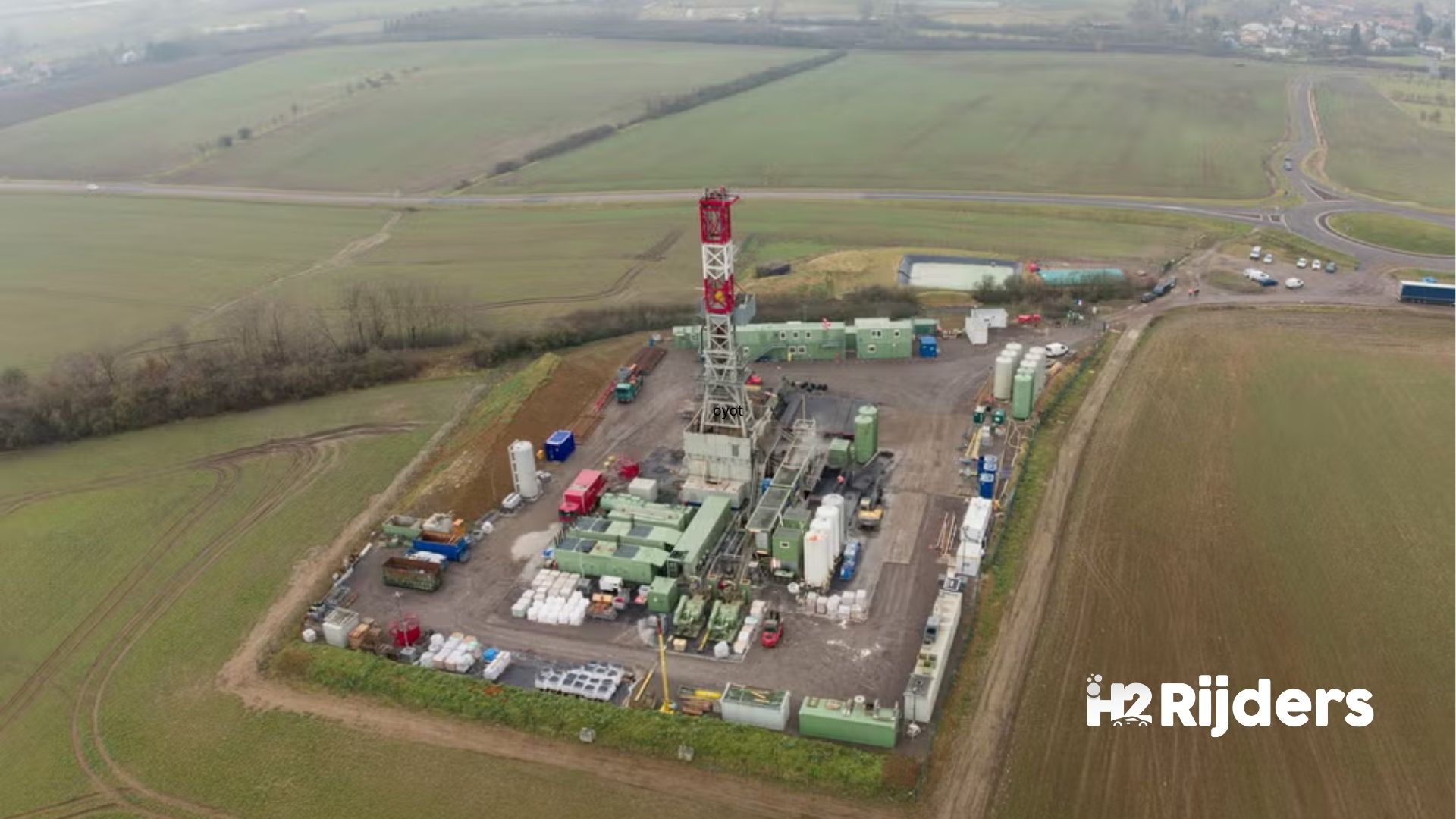
French energy company FDE (La Française de l'Énergie) reports a significant breakthrough in natural hydrogen exploration in the Lorraine region of northeast France. Post-drilling analyses of the PTH-2 well show hydrogen concentrations of 36.1% at 2,242 metres depth and 49.6% at 2,426 metres. FDE describes these as among the highest natural hydrogen concentrations ever measured in situ worldwide.
What is the PTH-2 well?
The PTH-2 well in Pontpierre (Moselle) is the world's deepest drilled exclusively for natural hydrogen exploration, reaching a final depth of 3,655 metres. Drilling took place under the REGALOR II research programme, led by FDE in collaboration with the University of Lorraine, CNRS, BRGM and Solexperts. The programme received €8.8 million in grants from the Grand Est Region and the European Union via the Just Transition Fund.
The results build on FDE's earlier Folschviller discovery from 2023, where the company measured 20% dissolved hydrogen concentrations at 1,200 metres depth. A recurring observation is that concentrations increase with depth — pointing to an active hydrogen production system in the subsurface.
What is natural hydrogen?
Natural hydrogen — also called geological or gold hydrogen — is hydrogen produced in the earth's crust through geochemical processes, primarily the reaction of iron-bearing minerals with water (serpentinisation). It is not a manufactured fuel like green or blue hydrogen, but a primary energy source present in the earth's crust. The potential advantages are significant: no electrolysis needed, no CO2 emissions at production, and potentially low production costs if concentrations and volumes are sufficient.
Technology for extracting and certifying such reserves is still in early stages. FDE uses its proprietary SYSMOG measurement technology, validated in collaboration with Solexperts.
Roadmap: certification in 2027, production late 2028 or early 2029
FDE targets an independent resource certification in 2027 — a necessary step to confirm commercial viability — followed by the start of industrial production in eastern France in late 2028 or early 2029. The company is also applying for an exclusive exploration permit covering the Trois-Évêchés area of 2,254 km², spanning the entire Lorraine Basin.
CEO Antoine Forcinal: "PTH-2 marks a turning point, not only for FDE but for the entire natural hydrogen industry. We are no longer discussing a scientific hypothesis; we are progressively de-risking what could become one of Europe's first industrial-scale natural hydrogen projects."
Relevant for the energy transition?
Natural hydrogen is distinct from the manufactured green and blue hydrogen currently on the market. Its potential is significant: local, low-carbon and possibly cost-competitive. But the sector remains at an early stage. FDE is one of the few players globally able to demonstrate serious measurement results at industrially relevant depths. Whether and when this leads to a stable supply for mobility or industrial applications remains uncertain — but the direction is promising.
Sources
- FDE official press release, 23 June 2026 (Euronext / live.euronext.com)
- H2 Bulletin (h2bulletin.com)
- NatH2Investing — REGALOR II background (December 2025)
- Hydrogen Insight — exclusive exploration permit (January 2026)


