
Germany commits €220 million to hydrogen refuelling network for heavy transport
Germany commits €220 million to hydrogen refuelling network for heavy transport
Germany's Federal Ministry of Transport (BMV) opens a €220 million funding call for hydrogen refuelling infrastructure for heavy commercial vehicles. Coordinated by NOW GmbH and implemented by Projektträger Jülich, the programme targets up to 40 new publicly accessible hydrogen stations along Germany's main transport corridors. The application window ran until 31 May 2026.
How the funding works
The scheme centres on a package approach: refuelling stations and hydrogen vehicles are funded together. This breaks the classic deadlock — without enough vehicles a station cannot be profitable, but without stations nobody invests in hydrogen trucks.
Concretely:
- Hydrogen refuelling stations are eligible for up to 50% subsidy on eligible costs
- New trucks and buses (class N2 and N3) with hydrogen drivetrains — both fuel cell and combustion engine — receive up to 80% subsidy on the additional investment costs compared with an equivalent diesel vehicle
- Target: up to 40 new stations and 400 new hydrogen vehicles by 2030
- Stations must comply with the European AFIR regulation on alternative fuels infrastructure
New: H2-ICE vehicles explicitly eligible
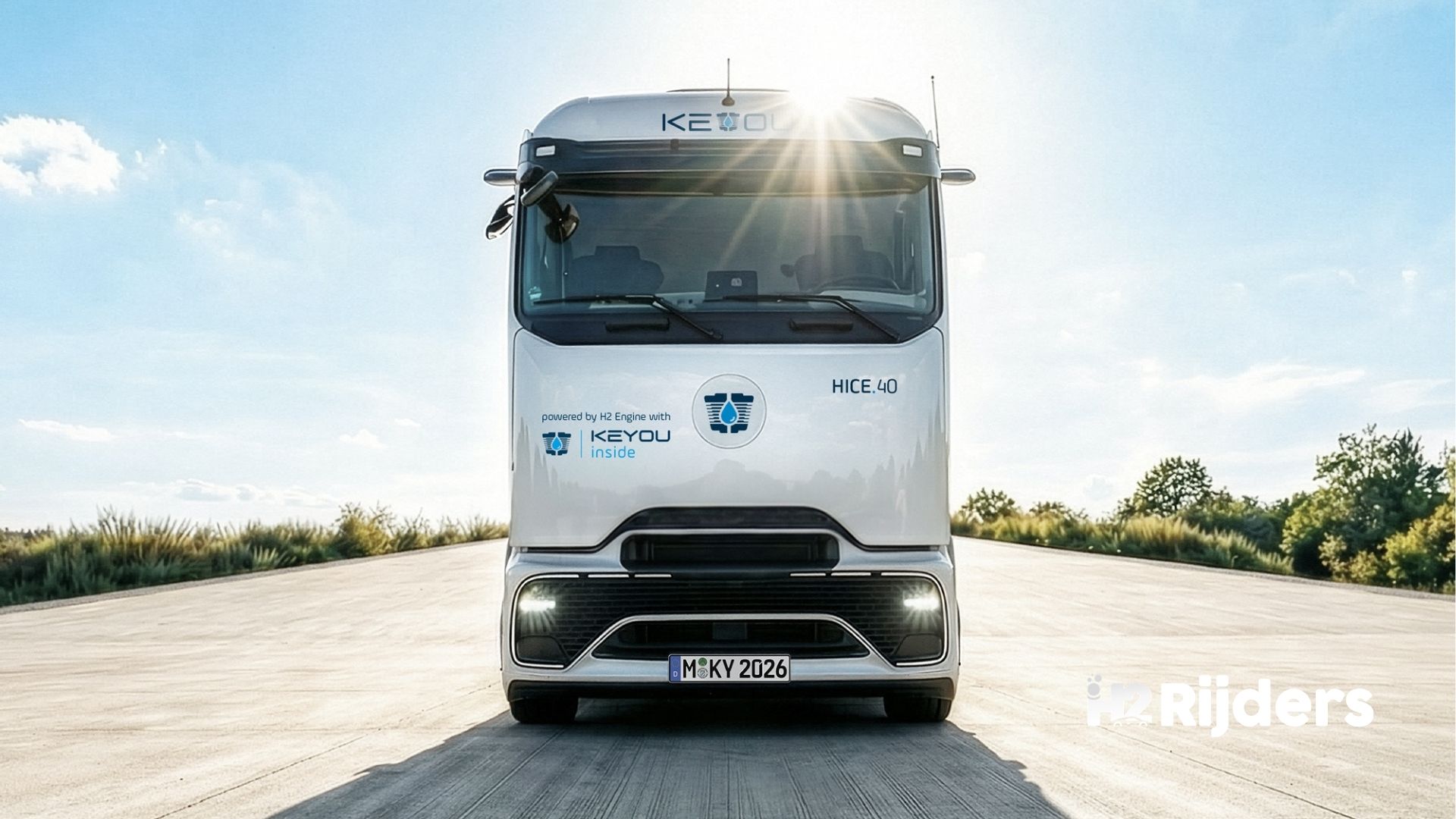
A notable feature of the 2026 call is that hydrogen internal combustion engine vehicles (H2-ICE) are explicitly included alongside fuel cell vehicles. This aligns with the broader European recognition of H2-ICE — such as the recently announced KEYOU HICE.40 based on the Mercedes-Benz Actros — as a fully valid zero-emission option for heavy transport.
Minister Patrick Schnieder (BMV): "Hydrogen plays an important technical, economic and geopolitical role in climate-friendly heavy transport and is a meaningful complement to battery-electric drivetrains. With this funding we solve the chicken-and-egg problem: truck drivers find reliable refuelling options and stations are utilised from the start. Step by step, a reliable basic network takes shape."
Context: the Netherlands follows a parallel path
The Netherlands runs a comparable scheme through the Subsidieregeling Waterstof in Mobiliteit (SWIM). The third SWIM round (April–May 2026) made €45 million available. Two earlier rounds already resulted in seven new hydrogen stations, seven upgrades of existing stations, and around 600 subsidised vehicles, of which nearly 500 were trucks. The Netherlands currently has 23 public hydrogen refuelling stations, a number of which are suitable for heavy transport.
The parallel approach in Germany and the Netherlands shows that hydrogen infrastructure for heavy transport does not depend on a single large investment, but on targeted, demand-driven subsidies that build stations and fleets simultaneously.
Sources
- NOW GmbH press release Förderaufruf 01/2026 (now-gmbh.de)
- Alles over Waterstof (allesoverwaterstof.nl, February 2026)
- RVO.nl – SWIM subsidy scheme
- Vrachtwagenheffing.nl – SWIM third round (April 2026)
- Nederland Elektrisch – SWIM second round results


