
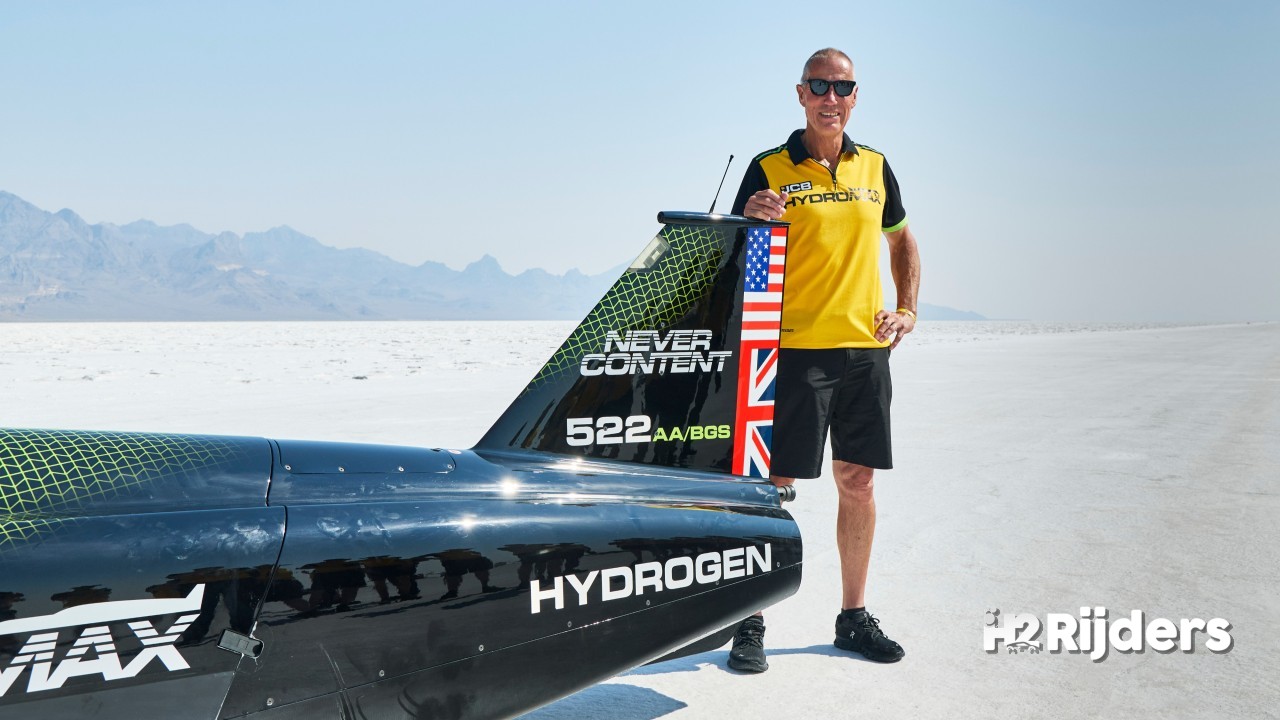
Hydrogen engine hits 592 km/h: JCB Hydromax breaks speed record at Bonneville
On the Bonneville Salt Flats in Utah, the JCB Hydromax set a new hydrogen speed record on 7 August. Across two runs the streamliner averaged 368.347 miles per hour, or 592.8 kilometres per hour. At the wheel was Wing Commander Andy Green OBE, the only person to have broken the sound barrier on land.
The two timed runs that make up that average were driven on consecutive days: 367.141 mph (590.9 km/h) and 369.554 mph (594.7 km/h). That topples the Southern California Timing Association class record, which had stood at 348.342 mph (560.6 km/h) since 2010. It is the first time in sixteen years that this class has a new name on it.
Two engines, 1,600 hp combined
The Hydromax is close to ten metres long and runs on two hydrogen combustion engines developed by JCB itself. Each delivers around 800 hp, for a combined 1,600 hp, driving all four wheels through a twin transmission and twin clutch. This is emphatically not a fuel cell car: the hydrogen is burned in a piston engine, just like petrol or diesel, but without CO2 emissions.
Aerodynamics have been improved over its predecessor, the JCB Dieselmax. Everything from suspension to traction control was simulated and tested, first on the runway at RAF Wittering in England and then on the salt. The team has now completed 44 test runs at Bonneville. Alongside JCB, Prodrive, Ricardo and Xtrac contribute to the project.
The same technology as in a backhoe loader
What makes the attempt interesting is where those engines come from. They are based on the hydrogen engine JCB builds in series for construction machinery: the same architecture as the 55 kW (74 hp) version fitted to the 3CX Hydrogen backhoe loader. They are heavily uprated for the record, but the foundation is ordinary production technology.
JCB has invested roughly 100 million pounds in developing these engines over the past five years. The 3CX Hydrogen has since received European type approval through eleven national authorities, making it the first series-production backhoe loader with a fully certified hydrogen combustion engine. That is more than a formality: without approval, conventional financing and leasing are not possible.
Next stop: the FIA world record
The 7 August result is an SCTA class record, set during SpeedWeek. The official world record attempt follows this week, under FIA supervision, with the engines running at higher output than during SpeedWeek.
The existing marks sit considerably lower. The world record for a hydrogen combustion vehicle stands at 187.62 mph (302 km/h), set by the BMW H2R in 2004. The fastest fuel cell vehicle, Ohio State University's Buckeye Bullet 2, reached 303 mph (488 km/h) in 2009. The Hydromax is already comfortably past both.
For JCB the attempt also carries symbolic weight. In 2006 the company set the diesel record at 350.092 mph (563.4 km/h) with the Dieselmax and the same driver, a record that still stands. The Hydromax has now surpassed it: at JCB, hydrogen is faster than diesel.
More than a speed stunt
A record on the salt is above all an endurance test. Engines that run at full output for days on end without failing say something about how robust the technology is. For a manufacturer that wants to sell those same engines in excavators and loaders, that is precisely the point.
"This project is about proving that hydrogen power can perform at the very highest level with zero emissions," said Lord Bamford, chairman of JCB. The timing is no accident: shortly after the record week, JCB opens a new 500 million dollar factory in San Antonio, Texas.
In brief
- Average of 368.347 mph (592.8 km/h) over two runs, Bonneville Salt Flats, 7 August 2026
- Driver: Wing Commander Andy Green OBE, holder of the outright land speed record (763.035 mph)
- Two JCB hydrogen combustion engines, around 800 hp each, 1,600 hp combined, four-wheel drive
- Previous SCTA class record: 348.342 mph from 2010; JCB Dieselmax in 2006: 350.092 mph
- The official FIA world record attempt follows this week, with engines at higher output
Sources
- JCB – JCB Hydromax powers to 368.347mph on road to FIA record attempt (7 August 2026)
- JCB – JCB targets new land speed record using its own hydrogen engines (May 2026)
- Highways Today – JCB Hydromax sets 368mph record ahead of FIA hydrogen world record bid
- Heavy Equipment Guide – JCB Hydromax beats Dieselmax top speed ahead of FIA world record attempt
- New Atlas – JCB Hydromax hydrogen car targets 350 mph world record


